
10x Single Cell Workflow
We provide end-to-end support for 10x Genomics single-cell projects, from planning and cell preparation to sequencing and analysis. Our team works to optimize each step for your goals and sample type, with access to advanced instruments, preparation tools, and on-campus resources to ensure high-quality, reproducible results.
Workflow Steps
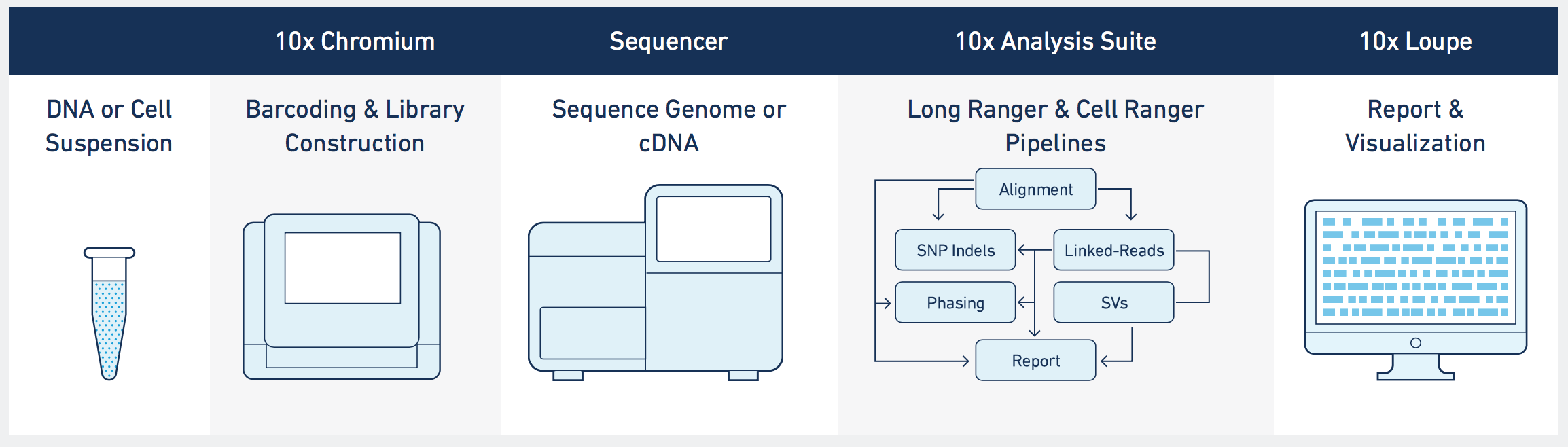
1. Consult
Start with a project planning meeting to review your experimental goals, discuss design options, and cover key logistics such as turnaround time, scheduling, suspension buffer, and cell concentration requirements (varies by assay). A dry run can be arranged to optimize your cell or nuclei preparation before moving to full-scale sequencing.
2. Cell Preparation
Cell or nuclei preparation, dissociation, and labeling are performed by the researcher. The 10x Genomics Cell Preparation Guide outlines best practices for washing, concentrating, resuspending, and counting cells; however, protocols should be optimized for your specific sample type. For samples requiring sorting, consult the University Flow Cytometry Resource (UFCR) before beginning a flow-sorting experiment.
As part of the UMGC CoLab, we provide access and training for:
- Singulator Platform – hands-off tissue dissociation into a single-cell suspension or nuclei isolation
- MACSQuant Tyto Cell Sorter – available as a CoLab instrument for gentle, closed-system cell sorting
- LeviCell – magnetic levitation for label-free live cell separation, accommodating samples up to 350 µm and enriching live cells for downstream applications
Coordinate with our team ([email protected]) to deliver dissociated suspensions of live cells or nuclei for immediate processing.
3. Capture & Library Prep
Using the latest 10x Genomics Chromium X, we can generate hundreds of thousands of single-cell partitions, each tagged with a unique barcode for downstream analysis. All 10x single-cell assays are available to provide maximum flexibility in experimental design.
4. Sequencing
An initial Element AVITI QC run verifies the number of targeted single cells before full-scale sequencing on the Element AVITI. Sequencing depth is determined by the assay type and number of cells captured. For high-throughput projects, the Ultima UG100 offers a cost-effective, scalable platform for single-cell library sequencing.
5. Data Analysis
We process single-cell gene expression datasets with the Cell Ranger Count pipeline, providing:

- An HTML report
- A
.cloupefile for the interactive Loupe Browser - Gene expression count data
- FASTQ sequence files
UMN researchers seeking further analysis or interpretation of Cell Ranger output can connect with the Research Informatics Solutions group at the Minnesota Supercomputing Institute.
Questions
Contact us at [email protected].